Table of Contents
Sand plays a crucial role in construction by ensuring a proper concrete mix and providing structural strength to buildings. Various types of sand are utilized depending on the specific application. To establish a resilient, long-lasting bond in concrete and masonry work, high-quality construction sand must be clean, structurally sound, and appropriately graded.
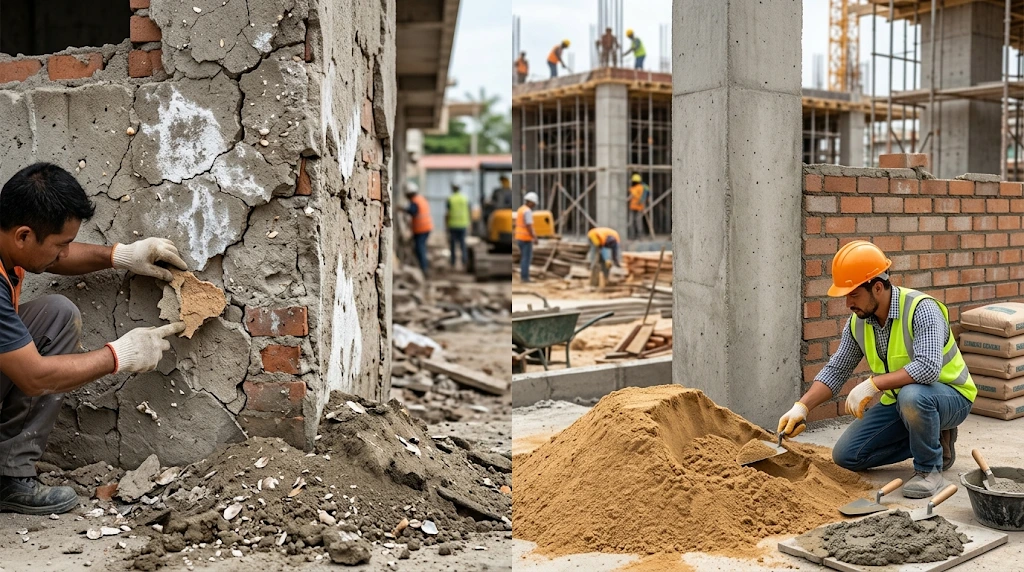
Features of good sand property
1.Cleanliness of sand:
High-grade sand must be rigorously devoid of silt, clay, dust, and organic contaminants, for their presence significantly undermines concrete compressive strength and erodes the long-term durability of the structure. In mixtures designed for enhanced performance and cohesion,
The fine particulate nature of silt and clay tends to encapsulate sand grains, thereby inhibiting the cement paste from achieving adequate adhesion.
This compromised interface directly results in a reduction of the structure’s overall load-bearing capacity.
2. Particle Shape:
The Spectrum of Roundness
Because natural sand is highly variable, researchers and geotechnical engineers classify particle shapes along a specific continuum to predict how a batch will perform in construction:
- Very Angular & Angular: Freshly broken rock with sharp, jagged edges and flat faces (e.g., crushed stone or manufactured sand).
- Sub-angular & Sub-rounded: Grains that have had their sharpest corners slightly worn down but still retain a generally blocky shape.
- Rounded & Well-rounded: Grains that have been smoothed into nearly spherical or oval shapes, with almost no flat faces or sharp edges (e.g., desert sand or older sea sand).
Geological Weathering: How Shape Changes Over Time
Mechanical (Physical) Weathering:
This is the physical grinding and breakdown of rocks over millennia. Sand that has been transported over long distances by water (fluvial action in rivers or ocean waves) or wind (aeolian action in deserts) constantly collides with other particles. This friction acts like geological sandpaper, gradually grinding off the sharp, angular edges until the grain becomes highly rounded and polished.
Chemical Weathering:
Minerals within the sand react with water, carbon dioxide, or organic acids in the environment. This can dissolve softer minerals within a single grain, altering its surface texture. In some cases, chemical weathering smooths the grain further; in others, it selectively dissolves parts of the grain to create microscopic pitting and roughness, which can unexpectedly improve cement adhesion.
3. Gradation:
A well-proportioned blend of coarse, medium, and fine particles reduces internal voids in well-graded sand, lowering the amount of cement paste needed for effective bonding. When sand is well-graded, it achieves this high packing density:
*Coarse particles (e.g., 2mm to 4.75mm): Form the primary structural framework and bear the brunt of compressive loads.
*Medium particles (e.g., 0.425mm to 2mm): Wedge into the primary voids left by the coarse framework, preventing them from shifting.
*ine particles (e.g., 0.075mm to 0.425mm): Pack into the secondary microscopic voids, creating a highly dense, practically solid mass before any binder is even added.
4. Chemical Inertness:
Chemical inertness in construction aggregates means the material acts strictly as a stable structural filler and does not undergo unwanted chemical reactions with cement, water, or the environment. When sand lacks this inertness, it introduces destructive compounds into the concrete matrix.
Corrosion of Embedded Steel (Concrete Spalling) Concrete is naturally highly alkaline (pH 12-13), which creates a protective chemical “passivation layer” around embedded steel rebar, preventing it from rusting. Chlorides aggressively attack and break down this barrier.
Alkali-Silica Reaction (Concrete Cancer) If the sand contains reactive silica and the cement is high in alkalis, they can react in the presence of moisture to form a viscous, swelling gel. As this gel absorbs water over time, it expands relentlessly, causing severe internal cracking and degrading the load-bearing capacity of the structure over a period of years.
5. Sand Durability:
Each individual grain must remain physically tough, resilient, and highly resistant to chemical breakdown, weathering, and crushing.
Physical Toughness and Crushing Resistance When subjected to structural loads, the aggregate carries a significant portion of a building’s compressive stress. Individual sand grains must possess enough inherent mineral hardness to resist fracturing, shearing, or pulverizing. This toughness is critical not only to support the final structural load but also to survive the severe abrasive forces encountered inside a concrete mixer.
Resilience Against Weathering Building materials are subjected to decades of continuous environmental stress. Durable sand grains must maintain their physical structure through constant thermal cycling expanding and contracting from extreme daily heat and cooling as well as prolonged moisture exposure.
6. Proper Bulk Density and Fineness Modulus:
What Fineness Modulus Actually Measures:
Run a sand sample through a standard set of sieves and record how much material stays on each one. Add those cumulative retained percentages together and divide by one hundred. That’s the fineness modulus calculation, and the number you end up with tells you where the sand sits on the scale between fine and coarse. Most construction sand used in concrete work lands somewhere between 2.3 and 3.1.
The fineness modulus basically tells you where the sand is, before you lock in a mix design , which is precisely when that info is most useful.
Methods to check sand quality before construction
1. Visual Inspection Test
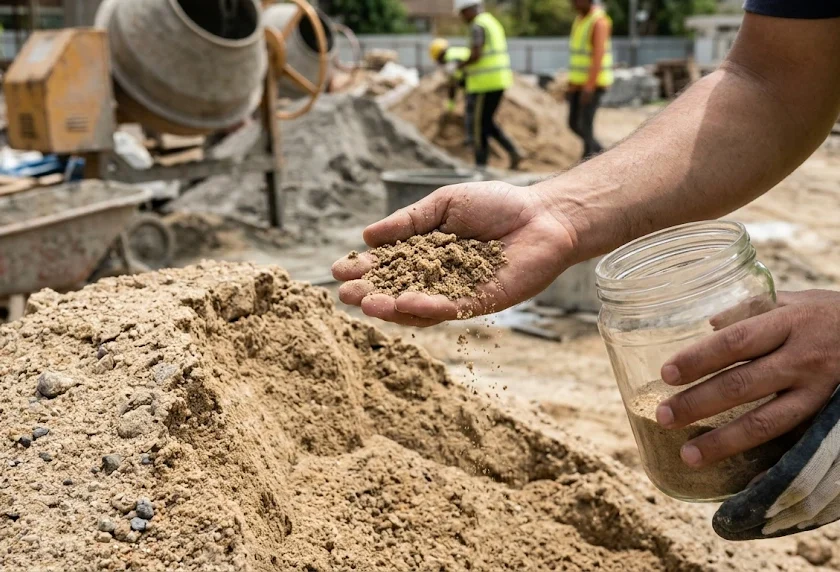
Visual inspection is the fastest initial check for site sand quality. Spread a sample on a clean surface to observe its color, shape, and cleanliness.
Quality sand is clean, free-flowing, and free of debris like leaves, roots, plastic, or excessive dust. When rubbed between fingers, it should feel gritty rather than sticky or clay-like.
While not a substitute for laboratory testing, visual checks quickly flag poor-quality material that appears muddy or leaves stains for further evaluation.
2. Sieve AnalysisTEST
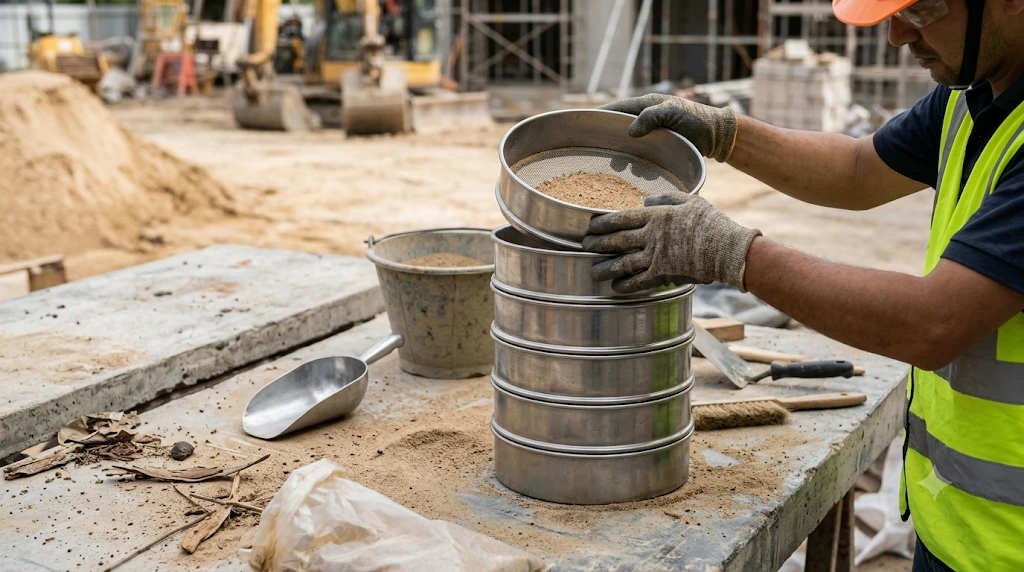
Sieve analysis determines sand particle size distribution by passing a dry sample through standard sieves and weighing the retained material.
Properly graded sand optimizes particle packing and reduces voids, ensuring good concrete strength while minimizing cement and water requirements.
Overly fine sand increases water and cement demand, whereas overly coarse sand reduces workability, making sieve analysis critical for mix design and quality control.
3. Organic Matter Test
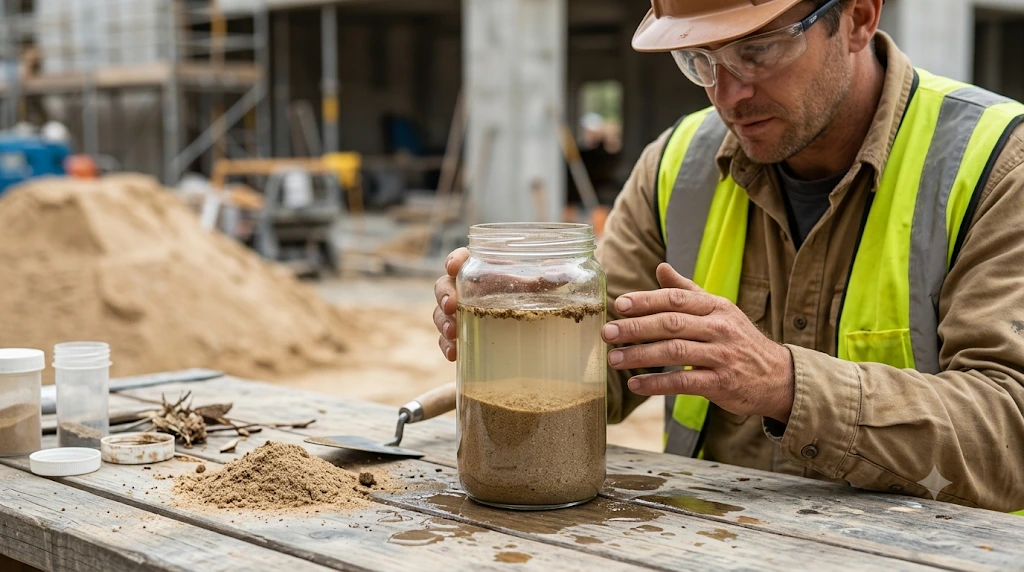
Organic impurities such as decayed leaves, roots, humus, and other plant matter can interfere with cement setting and strength development. Dark or dirty-looking sand should always be checked for organic matter before use.
A common field test uses a sodium hydroxide solution. Sand is mixed with the solution in a glass container and left undisturbed. If the liquid turns dark brown, it may indicate harmful organic impurities. A lighter colour generally suggests lower organic contamination.
This test gives an indication, not a complete material certificate. If the result is doubtful, send the sand to a laboratory before using it in concrete or important masonry work.
4. Clay Lumps and Deleterious Materials Test
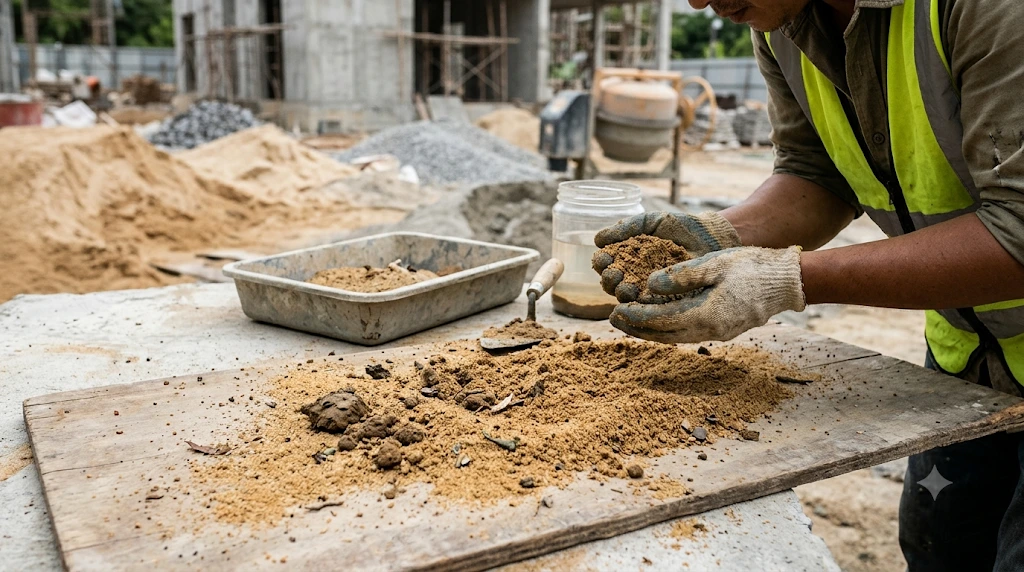
Impurities like clay lumps, mica, and shells weaken sand and degrade mortar or concrete quality.
Check dry sand on site by crushing visible lumps clay breaks easily into sticky or powdery residue. Lab testing provides precise measurement by weight. Clay-rich sand causes shrinkage cracks, weak bonding, and poor surface finishes after drying
5. Field Performance and Trial Mix Check
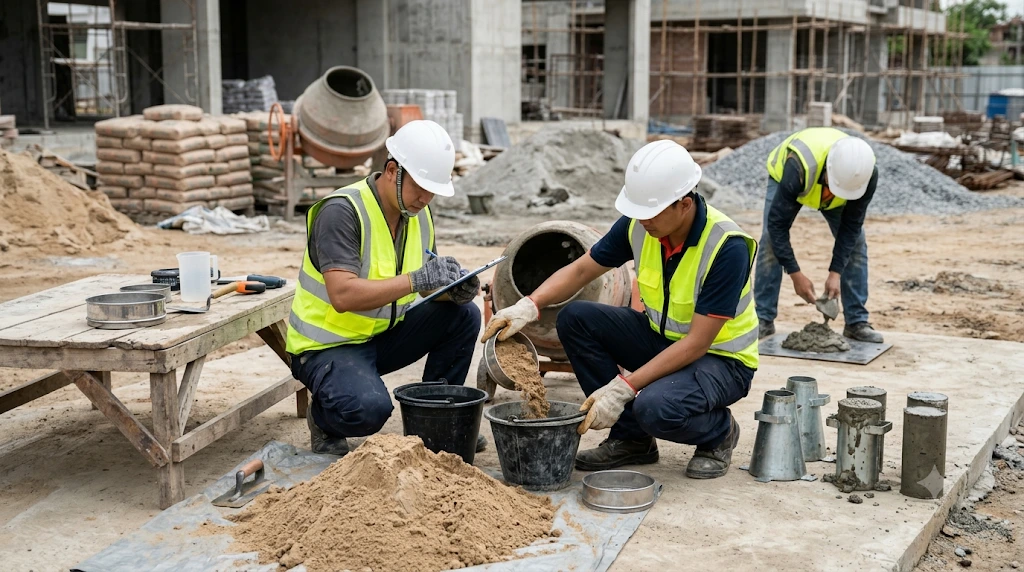
Testing sand behavior in trial mixes ensures it coats evenly and remains workable without requiring excess water or feeling sticky. Evaluating mortar spreadability, plaster finish, and concrete workability helps identify poor sand quality before full application.
While not a replacement for lab testing, trial mixes link test results directly to practical site performance.
The structural integrity of any long-lasting building depends heavily on the microscopic quality of its raw materials, not merely its architectural plan. High-grade construction sand requires optimal grain angularity, proper gradation, chemical stability, and physical resilience to establish a durable bond with cement.
Disregarding sand quality by overlooking high silt content, organic contaminants, or reactive substances creates hidden structural flaws, resulting in spalling, shrinkage cracking, and a significantly shortened lifespan for the building.
Partner with Mangalore’s Trusted Construction Experts
In coastal regions like Mangalore and Udupi, selecting high-grade construction materials is critical to combat heavy monsoons and saline air. When you partner with Sri Lakshmi Construction, you eliminate the guesswork and risk associated with poor material selection. Our turnkey civil engineering team strictly sources and tests the highest-quality materials—including legally compliant Manufactured Sand (M-Sand) and specialized sand pad foundations to guarantee the safety and longevity of your build.
Don’t compromise on your project’s foundation. Contact our engineering team today for a site evaluation and a transparent material consultation.
FAQs
How can I quickly check sand quality on-site before construction?
You can perform a quick visual inspection to check for debris and do a simple rub test quality sand should feel gritty, not sticky or muddy. For a deeper field check, you can use a sodium hydroxide solution to test for organic impurities or crush visible lumps to check for clay content.
Why is angular sand preferred over rounded sand for concrete?
Angular, sharp, and coarse sand grains provide superior mechanical interlocking and bonding with cement compared to smooth or rounded grains (like older sea sand). This strong interlock significantly increases the overall load-bearing capacity of the structure.
What happens if construction sand contains too much silt or clay?
High levels of silt and clay act as a barrier, encapsulating the sand grains and preventing the cement paste from adhering properly. This weak interface lowers the concrete’s compressive strength and causes shrinkage cracks as it dries.
Why is sea sand dangerous for building construction?
Sea sand lacks chemical inertness and contains reactive marine chlorides. These chlorides aggressively attack the protective alkaline layer around embedded steel rebar, causing it to rust and expand. This leads to internal cracking and severe concrete spalling (concrete cancer) over time.
What is "well-graded" sand and why does it reduce cement costs?
Well-graded sand contains a balanced blend of coarse, medium, and fine particles. The smaller particles naturally pack into the voids left by the larger ones, creating a dense mass. This reduces the amount of expensive cement paste needed to fill empty gaps, allowing the paste to simply bind the particles together.