Table of Contents
Choosing the right type of cement is critical to the structural integrity, durability, and performance of any construction project especially given regional environmental factors like coastal humidity, heavy rainfall, and variable soil conditions.
Let’s explore various types of cement employed in contemporary construction, grouped according to their use in different structures and their physical features.
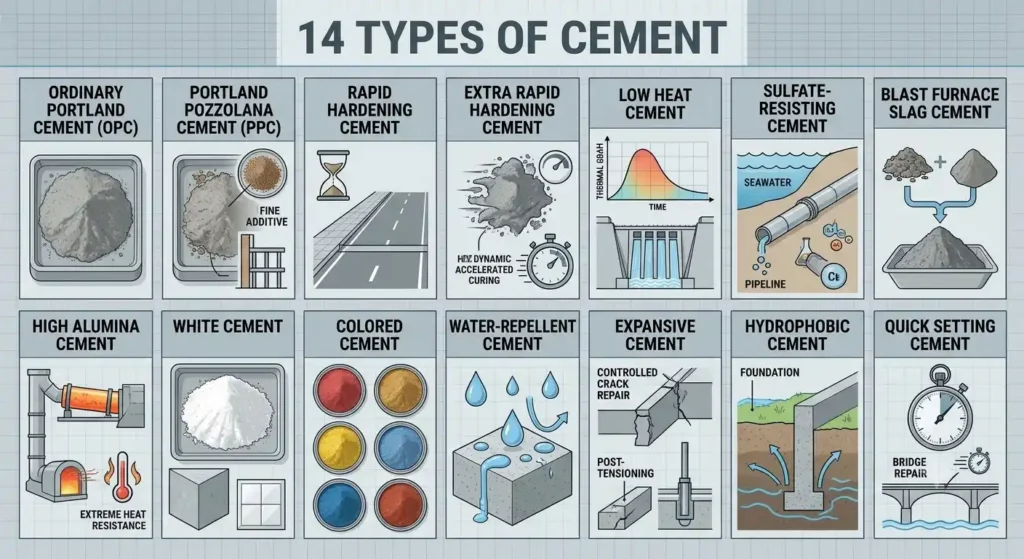
1. Ordinary Portland Cement (OPC)
Portland cement, or OPC, is by far the most preferred type on the worldwide market. It basically consists of limestone and clay mixed with a few other materials like sand or shale that can be described as either argillaceous or calcareous. These are then finely ground with water to form a cement paste. This paste hardens by reacting with water.
- Key Variants: They include different OPC types according to their strength, e.g., OPC 33, OPC 43, and OPC 53 (where a number represents a minimum compressive strength after 28-day hydration in MPa).
- Primary Applications: Civil engineering works, high-rise buildings, commercial and residential buildings made of Reinforced Cement Concrete (RCC), pre-stressed concrete elements and roadways requiring high strength.
2. Portland Pozzolana Cement (PPC)
Made by inter-grinding OPC clinker with pozzolanic materials such as fly ash (typically 15–35%), volcanic ash, or calcined clay.
- Main Features: It has a slower release of heat during curing and, over time, gives a more compact cement concrete. Portland Pozzolana Cement is a very good material for chemical attacks, cracks, and water resistance.
- Common Uses: Heavy concrete constructions (like dams and foundations, retaining walls), coastal and maritime structures due to its high sulfate resistance, and also for plastering and masonry works (where the lowering of cracks by heat is desired).
3. Rapid Hardening Cement
A specialized cement formulated with a higher proportion of tricalcium silicate (and a finer particle grind than standard OPC.
- Main Attributes: It develops its strength extremely rapidly compared to OPC (ordinary Portland cement), reaching a 3-day strength level within about 30 hours.
- Primary Applications: Fast-track construction, road repairs where traffic disruption must be minimized, cold-weather concreting, and early removal of formwork/scaffolding.
4. Quick Setting Cement
Cement manufactured with a reduced or omitted amount of gypsum (which normally acts as a retarder), resulting in very rapid setting times.
Features: The product starts working on the surface in approximately 5 minutes, and it completely turns to stone in 30 minutes.
Primary Applications: Underwater construction, grouting works under running water, and emergency repair works in damp or active water-seepage zones.
5. Low Heat Cement
An exclusive formula that reduces the amount of heat produced during the process of chemical hydration in the cement by suppressing tricalcium aluminate and raising the level of dicalcium silicate.
- Main uses: Massive concrete structures like dams, thick foundation rafts, bridge piers, and large retaining walls where thermal cracking from excessive core heat is a risk.
6. Sulphate Resisting Cement (SRC)
A cement designed with a very low percentage of tricalcium aluminate (C3A), which prevents destructive chemical reactions with sulfates present in soil or groundwater.
- Primary Applications: Foundations in marshy soil, coastal structures exposed to saline groundwater, sewage treatment plants, and industrial drainage systems.
7. Blast Furnace Slag Cement (BFSC)
A combination of OPC (clinker) and a large quantity of granulated blast furnace slag, which is basically an iron production byproduct.
- Significant Features: Resistant to chlorides and sulfates at a much higher level than other cements; has very low heat generation; it produces a finish that is very smooth and very durable.
- Typical Uses: For example, works near the sea and in the sea (e.g. marine structures) as well as concrete in a massive quantity with a very heavy foundation of a building factory.
8. High-Alumina Cement (HAC)
Bauxite and limestone are fused at very high temperatures to yield cement rich in aluminum (alumina) content.
The Main Pros: It gives quick setting, gets very high initial strength, has good resistance even at high temperatures and to various types of chemicals and acids, besides being resistant to corrosion.
- General Uses: Fireproof layers of concrete for furnaces, chimneys in factories that are tall and structural elements used in chemical/thermal extreme applications.
9. White Cement
It is a form of white OPC (Portland Cement) made from raw materials free from coloring oxides (e.g., chalk and white clay) such that there are no impurities like iron oxides.
- Major Applications: Architectural finishing, colored tiles, terrazzo flooring, precast exterior panels, and exterior wall rendering.
10. Coloured Cement
Brightly colored pigments and colorants are first thoroughly milled and then blended with the base cement for the colored cement.
- Aesthetic Uses: The outer surface of the building, ornamental concrete paving slabs, colored concrete driveways, and contemporary building and architecture signs made with color.
11. Air-Entraining Cement
The air introduced by standard cement is intermixed with air-entraining materials (e.g., resins, fatty acids, or aluminum powders), which are specially developed compounds and the air-entraining agent that creates microscopic and evenly distributed air bubbles in the mix.
Pavements, highway barriers, exterior slabs, and structures subjected to harsh freeze-thaw cycles or major moisture changes.
- Beneficial Characteristics: Greatly strengthens the concrete’s ability to be weather-resistant from freeze-thaw effects and to endure regular climatic weather changes.
12. Expansive Cement
A type of cement that, due to the characteristics of its composition, has a mild expansion effect during the setting and hardening stages of the material in such a way that one would say instead of shrinking, it rather grows.
Mainly for: Filling anchor bolts with grOUT, repairing concrete cracks, and in post-tensioned concrete to counter the effects of natural drying shrinkage.
13. Hydrographic Cement
Cement treated with water-repellent compounds that coat the particles and prevent moisture absorption during storage and transit.
- Main Uses: Damp-proofing of concrete buildings that are constantly exposed to moisture, waterproof layers in basement floors, water storage systems, and construction works that encounter heavy rainfall.
14. Portland Limestone Cement (PLC)
It is an environmentally friendly substitute made up of OPC clinker that has been mixed with finely ground, high-grade limestone (usually ranging from 6% to 15%).
Main Features: Lower carbon footprint at the production stage while still maintaining good workability, finishability, and proper time-wise hardness.
- Basic Uses: The main structure of buildings, plastering work, and environmental building projects, either for commercial purposes or housing facilities.
Laying the Right Foundation for Your Project
Selecting the appropriate cement is not just about raw structural strength; it is about matching the material to the exact environmental and engineering demands of your site. Whether you need Sulphate Resisting Cement to combat saline coastal groundwater, Portland Pozzolana Cement for an eco-friendly residential build, or Quick Setting Cement for active water leakage, the correct choice prevents long-term degradation and costly structural distress down the line.
Planning a construction project in coastal Karnataka?
Building in environments with heavy monsoons and saline coastal air requires highly specialized material knowledge. Partner with Sri Lakshmi Construction, a premier civil contractor serving Mangalore and Udupi. From selecting the perfect dense concrete mix to executing specialized sand pad foundations, our turnkey engineering solutions ensure your commercial or residential structure is built to withstand the harshest coastal elements.
Frequently Asked Questions (FAQs)
1. Which type of cement is most suitable for residential house construction?
In the context of basic residential house construction, Portland Pozzolana Cement (PPC) and Ordinary Portland Cement (OPC 43 or OPC 53) are the most popular types. OPC is the go-to choice for the preliminary stages of structural framing, RCC columns and the casting of slabs since it develops its strength at an early stage. On the other hand, PPC is recommended for finishing works, brick masonry, and base courses in the form of slabs since it emits less heat, has better resistance to moisture and chemical attacks, and is able to prevent the development of micro-cracks in the structure over the lifetime of the building.
2. What is the main difference between OPC and PPC cement?
The main difference is in their composition and hydration properties:
- OPC (Portland Cement Ordinaire/White Cement) is composed of limestone and clay clinker crushed to powders, with gypsum added for setting speed, and has higher early compressive strength.
- PPC (Portland Pozzolana Cement) is 15% to 35% made up of pozzolanic materials (e.g., fly ash). It sets slowly and releases a lesser amount of heat, and over the years it becomes a denser matrix with better resistance to humectant (water) penetration, sulfates, and weathering.
3. Which cement should be used for coastal areas and damp soil foundations?
In coastal regions or marshy soil with high salinity and groundwater sulfates, Sulphate Resisting Cement (SRC) or Blast Furnace Slag Cement (BFSC) is recommended. For mass foundations prone to heavy rainfall, Hydrographic Cement or Portland Pozzolana Cement (PPC) is also widely utilized because their low permeability prevents salt intrusion, steel rebar corrosion, and chemical degradation.
4: Why is Quick Setting Cement used instead of Rapid Hardening Cement?
Although both sound similar, they serve completely distinct engineering functions:
- Quick Setting Cement loses its plasticity within 5 minutes and sets hard in 30 minutes (due to reduced gypsum), making it ideal for underwater concreting and active water leakage repairs.
- Rapid Hardening Cement maintains standard initial setting times. Still, it gains high compressive strength very rapidly (achieving 3-day strength in 24–30 hours) due to finer grinding and higher C3S content, making it suitable for fast-track construction and early formwork removal.
5: What type of cement is best for eco-friendly or sustainable building projects?
Portland Limestone Cement (PLC) and Portland Pozzolana Cement (PPC) are the leading choices for sustainable, low-carbon building projects. By replacing a portion of clinker with finely ground limestone or industrial byproducts like fly ash, these blended cements reduce industrial carbon dioxide emissions during manufacturing while enhancing long-term concrete workability and durability.